 Courtyard Farm aims to combine profitable farming with providing an environment where native wildlife can thrive, and public access is encouraged. For wildlife, this means building up a healthy, living soil to benefit insects and native plants which, in turn, attracts birds and mammals. With an organic system, it is possible to marry the farm's objectives of providing crops for food without artificial pesticides or fertilisers, while providing an ideal habitat for wildlife. The farm is also an enjoyable, and safe, place to visit.
Courtyard Farm finished converting to organic in 2000, and meets the highest Soil Association organic standards. The farm, as it is now, was the vision of the late Peter Melchett, environmental campaigner, former director of Greenpeace UK and Policy Director of the Soil Association.
Organic farms also employ more people than intensive farms (in Eastern England, for non-organic farms this can mean less than one farm worker per 1,000 acres). Courtyard Farm employs one full-time working farm manager, Jay Mond Wedd, and with regular part-time workers this provides the equivalent of two full -time jobs, on 890 acres.
Sheep and cattle from a nearby organic farm spend the Summer months grazing on the wild flower meadows and clover fields at the farm. Cattle also graze on the farm's marshes at Holme, and spend the Winter in our cattle building.
Organic animals stay with their mothers longer than non-organic (whether 'outdoor', 'free-range' or intensive). Organic animals grow more slowly, eat natural diets, can always move around freely, and live in settled groups to minimise stress. |
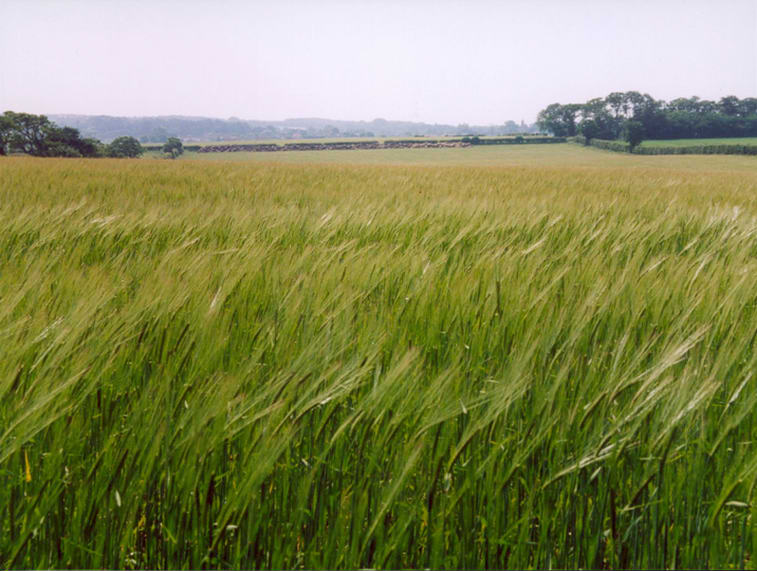
Wheat, barley (above), beans and red clover are the main crops grown in the six-year rotation at Courtyard Farm. The wheat, barley and beans are grown for use as seed by other organic farmers, demanding very clean fields and high quality grain. The beans are then used for animal feed, the wheat for animal feed or milling for bread and biscuits, and the barley for animal feed or malting for beer.
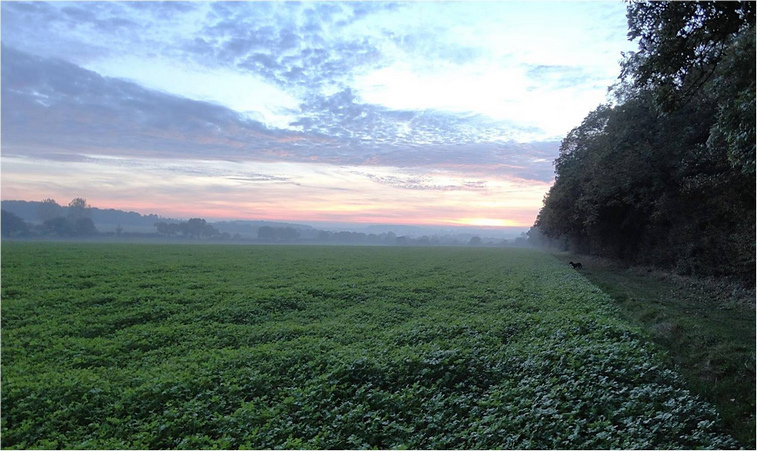
Clover is essential in an organic system for putting nutrients back into the soil without using artificial Nitrogen fertilisers, made from fossil fuels. The energy from sunlight allows clovers (and crops like beans, also grown at Courtyard) to fix Nitrogen in their roots, which is vital for growing crops. After growing under a wheat crop for one year, the clover remains undisturbed for two more years, to maximise Nitrogen fixing. The clover fields are cut for silage (to feed the cattle in winter) and sometimes grazed by young cattle in summer. Manure from the cattle also adds some fertility to the soil, mainly in form of Phosphorus and Potassium, the other two elements vital for growing crops.
Over the Winter, we grow a cover crop, usually mustard (below) or vetch, to prevent any soil erosion and to hold the nutrients for the next crop, planted in the Spring.
| |
|
|
| | |
|